
Why a washing machine stops draining, the safe checks you can make from the outside, and the signs that it needs a repair engineer.
A washing machine sitting at the end of its cycle with a drum full of cold, soapy water is one of the most frustrating appliance faults you can come home to. It is also a very common fault. The good news is that the cause is often something straightforward. The less good news is that it is not always something you can fix yourself without making things worse.
This guide walks through the main reasons a washing machine stops draining, the checks you can safely carry out from the outside of the machine, and the signs that point clearly to a job for a qualified engineer. Whether you are in washing machines in Plymouth, out towards the Tamar Valley, or further into Devon and Cornwall, the fault pattern is the same.
Before anything else: switch the machine off at the wall and unplug it. If water is still sitting in the drum, also turn off the water supply to the machine at the isolation tap behind or beneath it. Do not attempt to open the door by forcing the seal or bypassing the door lock.
The Most Common Reasons a Washing Machine Will Not Drain
There is rarely a single cause that accounts for every case, so it is worth understanding the main possibilities before assuming the worst. A careful look at the symptoms often points you toward the right area.
- Blocked pump filterMost front-loaders have a small filter, usually behind a flap at the bottom front of the machine, that catches coins, hair grips, buttons and fluff. When it blocks completely, the pump cannot shift water through it. This is the first thing to rule out.
- Blocked or kinked drain hoseThe corrugated hose at the back carries water from the pump to the standpipe or waste connection under the sink. If it has been pushed too far into the standpipe, kinked during a move, or has built up a grease and lint blockage, water cannot pass through.
- Blocked household standpipe or waste trapSometimes the machine itself is fine and it is the plumbing it empties into that is blocked. If the sink nearby drains slowly as well, that is a strong indicator.
- Failed drain pumpThe pump is an electrically driven impeller. It can fail because a foreign object has jammed the impeller, because the motor winding has burned out, or because the capacitor that starts it has given up. A failed pump usually makes a humming noise with no movement, or no sound at all when the drain cycle should be running.
- Faulty door interlockSome machines will not begin a drain cycle if the door lock has not confirmed the door is shut. A failing interlock can cause the machine to stall part-way through a programme.
- Control board or programme faultLess common, but a fault on the main electronic board can mean the drain signal never reaches the pump. This is usually accompanied by an error code.
- Pressure switch or pressure hose faultThe machine uses a pressure switch to sense water level in the drum. If the small hose connecting the drum to the switch is split, blocked or disconnected, the machine may think the drum is empty when it is not, or refuse to drain because it cannot get an accurate reading.
What You Can Safely Check Yourself
There are a handful of checks that require no tools, no dismantling and no specialist knowledge. Work through these in order before concluding that you need professional help.
- Unplug the machine and turn off the water supply. This is non-negotiable. Do it before anything else.
- Check the programme settings. Some machines have a spin-only or rinse-hold option that deliberately keeps water in the drum. Confirm you ran a full wash cycle, not an incomplete or paused one.
- Inspect the drain hose at the back. You can pull the machine out slightly and look at the hose without removing it. Check it is not kinked, crushed behind the machine, or pushed too far down into the standpipe. A hose shoved right down into the standpipe can create a siphoning effect or simply block the path of water.
- Check whether the sink or standpipe it empties into drains freely. Run the tap. If it drains slowly, the blockage may be in the household waste system, not the machine at all.
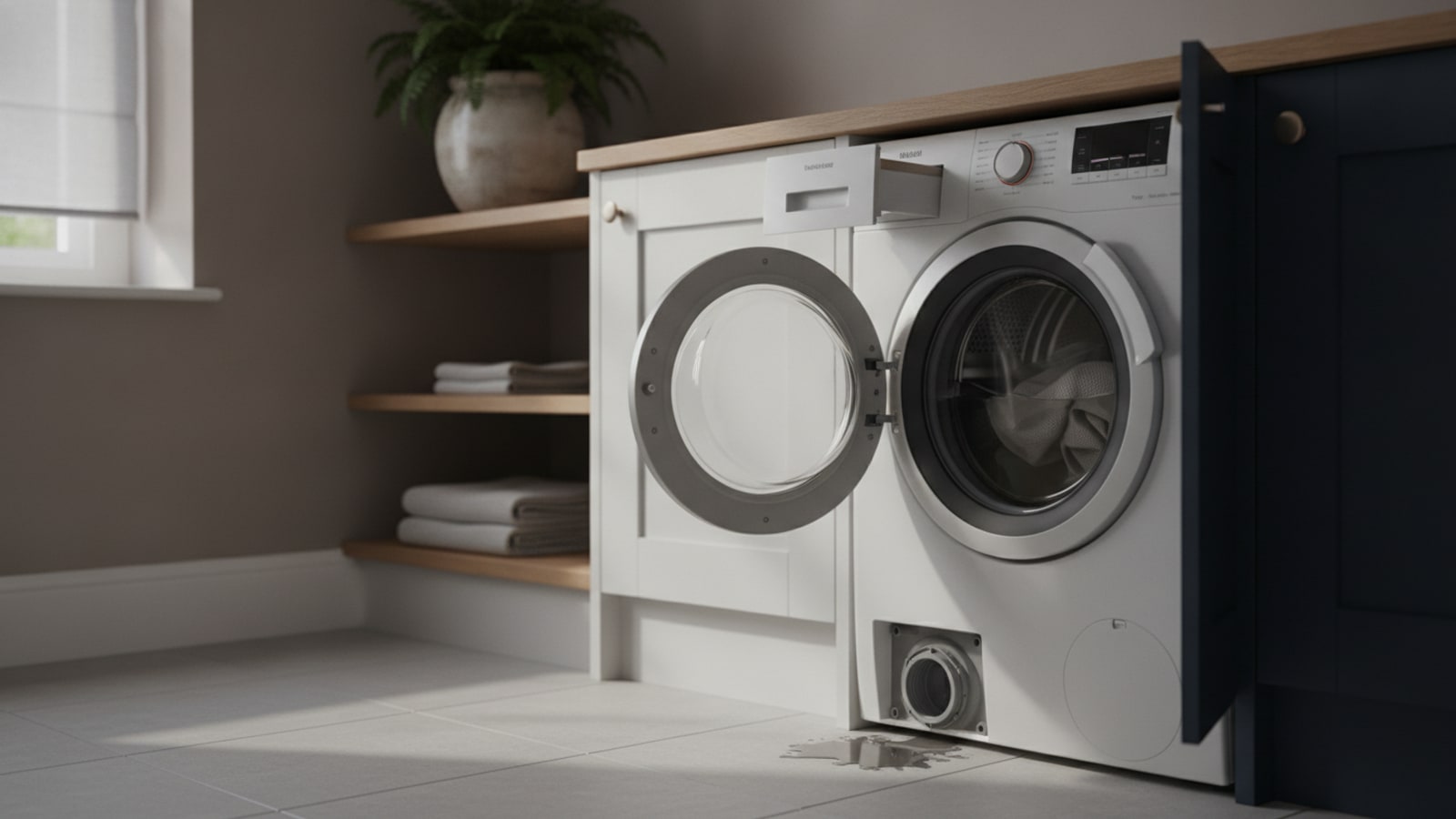
- Access the pump filter. On most front-loaders, there is a small square or round flap at the bottom front. Place an old towel and a shallow tray or baking dish beneath it before opening it - there will be water. Open the flap slowly, let the water drain into the tray, then unscrew the filter cap anticlockwise. Remove any debris, check the impeller behind the filter for obstructions (you can gently turn it with a finger to feel whether it is seized), rinse the filter under a tap and refit it firmly. Do not leave it loose.
- Check the fuse in the plug. A blown fuse will stop the machine entirely. Swap it for a new fuse of the same rating and see whether the machine powers back on.
What You Should Not Attempt
It is tempting to go further, especially if you are handy around the house. But there are clear limits to what a homeowner should do without training and the right equipment.
Do not remove the back panel, top panel or any other casing from the machine. Some internal components can hold a dangerous electrical charge even after the machine has been unplugged. Do not attempt to replace the pump, pressure switch, door interlock or control board yourself unless you have relevant electrical training. Do not bypass or tape the door lock to force the machine to run. And do not attempt to empty the drum by tipping the machine - the counterweights and drum can shift unexpectedly.
If water is still in the drum and you cannot drain it through the filter, leave it. An engineer can pump the drum down safely as part of the repair.
Signs It Is Time to Call a Professional
Most people know intuitively when a job has gone beyond a simple clean or adjustment. Here are the specific indicators that point to an internal fault requiring a professional repair:
- Humming during the drain cycle but no water movementThe pump motor is receiving power but the impeller is jammed or the motor winding has failed.
- No sound at all during the drain cycleThe pump is not receiving a signal, or the motor is completely dead.
- Filter is clear but the machine still will not drainThe fault is upstream of the filter, most likely the pump, pressure system or control board.
- Error codes that persist after a resetPersistent codes usually indicate a sensor or component failure rather than a temporary glitch.
- Water leaking from beneath the machineA drain fault combined with a leak can mean a split hose or a pump housing crack, either of which needs proper diagnosis.
- The machine worked fine until it was movedA move can dislodge the drain hose connection at the pump, a job that requires partial disassembly to inspect properly.
What an Engineer Will Do
When an engineer visits, they will systematically work through the possible causes, starting with the simplest and moving to the more involved. That typically means confirming the filter and hose are clear, then testing the pump electrically with a multimeter to check whether it is receiving voltage and whether the motor itself has continuity. They will also check the pressure switch and its hose, and read any stored fault codes from the machine's memory if the model supports that.
If the pump needs replacing, that involves disconnecting the machine from its water supply, draining it properly, removing the relevant panels and unclipping the pump from the sump hose and its electrical connector. It is a contained job on most common machines, but it does need to be done correctly to avoid a subsequent leak. For washing machine repairs of this type, having the right replacement part for the exact model matters - a generic pump from a hardware shop is rarely the right fit.
FAQ
Can I still use my washing machine if it is not draining?
No. Running a machine that cannot drain risks flooding your laundry room and can burn out the pump motor if it runs dry or under excessive load. Leave the machine unplugged until the fault is resolved.
My machine drained but then stopped draining on the next wash. Is that normal?
Not normal, but it sometimes happens when a partial blockage in the filter or pump clears temporarily. Clean the filter thoroughly and check the drain hose for a partial kink. If it happens again, the pump may be on its way out and is worth having inspected before it fails completely and leaves you with a drum full of water.
How do I know if it is the pump or the control board that has failed?
That distinction requires electrical testing with a multimeter and knowledge of the machine's wiring diagram. If the pump hums but does not shift water, the motor or impeller is more likely. If there is complete silence during the drain cycle and no error code, the board is a stronger candidate. An engineer can test both quickly and accurately.
The machine drained but left an inch of water in the bottom of the drum. Is that a fault?
A very small amount of residual water at the lowest point of the drum is normal on many machines and is not a sign of a drainage fault. If the water is more than a centimetre or two deep, or if the drum smells musty between washes, the filter may be restricting flow without blocking it completely.
Do you repair washing machines in Saltash and Torpoint as well as Plymouth?
Yes. We cover a wide area across Plymouth, Devon and Cornwall, including washing machines in Saltash and washing machines in Torpoint, as well as towns further afield such as Tavistock, Liskeard, Newton Abbot and beyond. Get in touch and we can confirm whether we cover your area.
Talk to a local appliance engineer
If you have worked through the checks above and the machine still will not drain, or if you would rather have someone with the right tools and experience take a look from the start, get in touch with us at All Appliance Care. We cover Plymouth, Devon and Cornwall, Monday to Saturday, 8am to 6pm. Give us a call or drop us a message and we will talk through what the machine is doing and arrange a visit.
Need a hand with this?
If you would rather have it looked at properly, we cover Plymouth, Devon and Cornwall.