
Our services
Cooker Hood Repair in Plymouth, Devon and Cornwall
Cooker hood repair covers extractor hoods whose fan has stopped or lost suction, that have become noisy, whose lights or controls have failed, or that drip grease. We diagnose the fault in your kitchen, explain it and agree the cost before any work.
01How it works
Cooker Hood Repair, explained
How it works
Your cooker hood, properly understood
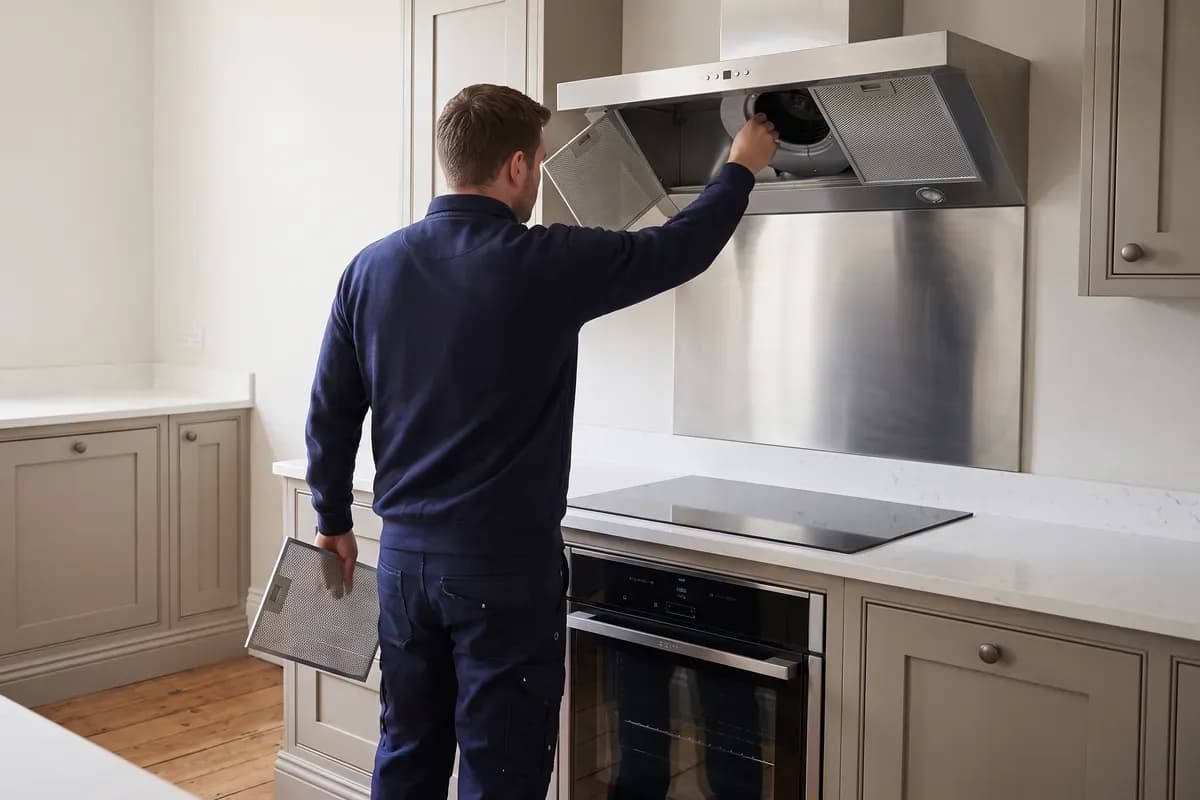
A cooker hood removes airborne grease, steam and cooking odours from the kitchen. It draws air through a grease filter using an internal motor and fan assembly. Depending on the setup, this air is either vented outside through ducting or passed through a carbon filter and recirculated back into the room. The control board or mechanical switches manage the fan speeds and the integrated lighting. Over time, the constant exposure to moisture and vaporised cooking oils takes a toll on the internal components. Grease can bypass saturated filters and coat the motor bearings, causing the fan to become noisy, vibrate or seize entirely. Switches and electronic control modules are also vulnerable to moisture ingress, which can lead to unresponsive buttons or lights that refuse to turn on. Sometimes, the ducting itself becomes restricted, forcing the motor to work harder and eventually fail. Diagnosing a cooker hood requires inspecting the unit in place above the hob. The process begins with checking the power supply and the condition of the control switches. If the motor is struggling or dead, the casing is opened to examine the fan blades, the motor windings and the bearings for grease build-up or electrical failure. The lighting circuit, including the transformers for low-voltage bulbs, is tested with a multimeter to find where the voltage drops.
02Know the signs
When it is time to call us
01
The fan motor hums but the blades do not spin.
02
Steam rolls past the hood instead of being drawn inside.
03
The appliance makes a loud rattling sound on high speeds.
04
Grease is visibly dripping from the filter or motor housing.
05
The control buttons feel sticky and fail to engage properly.
06
The integrated lights flicker or remain off after a bulb change.
03Common faults
What usually lies behind it
01
Motor running but no air extraction
When the fan motor sounds like it is running but steam is not being cleared, the airflow is restricted. This happens when grease filters are completely blocked or the external ducting has collapsed. In some cases, the fan impeller has detached from the motor shaft.
02
Loud vibrating noises during operation
A cooker hood that vibrates heavily or makes a loud rumbling noise usually has a mechanical issue. Grease accumulation on one side of the fan blades throws the impeller off balance. Alternatively, the motor bearings have worn out and the entire motor assembly requires replacement.
03
Lights not working when switched on
If replacing the bulbs does not restore the lighting, the fault lies deeper in the appliance. Many modern hoods use a transformer to step down the voltage for halogen or LED lights. When this transformer or the main light switch fails, the lighting circuit loses power.
04
Control buttons stuck or unresponsive
Mechanical push buttons and electronic touch controls sit directly above the cooking area. Steam and vaporised oil enter the switch housing, causing the contacts to stick or short out. The control board or the individual switch unit must be tested and replaced to restore function.
05
Grease dripping from the hood casing
Extractor hoods are designed to trap grease, but they have a limited capacity. When the metal mesh or paper filters become completely saturated, the excess oil pools inside the plastic motor housing. This oil eventually leaks through the panel gaps and drips onto the hob below.
04Questions
Cooker Hoods: your questions
Not answered here? Tell us the make, the model and what the appliance is doing.
Call 01752 922765Not always. Clogged grease filters are a common cause of weak extraction. If cleaning or replacing the filters does not help, the motor or fan may need attention.
A rattling sound points to a physical imbalance or loose component inside the casing. The fan impeller might be damaged or coated in uneven grease deposits. Worn motor bearings also cause the shaft to vibrate against its housing, which creates a loud noise that worsens on higher speed settings.
We only repair cooking appliances in electric and induction setups. We do not work on gas cookers, gas hobs or any gas appliance. If your extractor hood is mounted above an electric or induction hob, we can inspect the motor, lights and controls to find the fault.
When new bulbs do not fix the issue, the lighting circuit has likely failed. The fault could be a broken mechanical switch, a damaged electronic control board, or a burnt out transformer. A multimeter is used to trace the voltage and identify which component is stopping the power.
Dripping oil happens when the grease filters are completely saturated and can no longer trap airborne particles. The vaporised cooking oil bypasses the filter, condenses on the cold plastic of the motor housing, and pools at the lowest point before leaking out through the seams of the appliance.
05Where we work
Cooker Hoods in your town
Choose your town for cooker hood repair there, nearest to Plymouth first.
Devon