
Our services
Microwave Repair in Plymouth, Devon and Cornwall
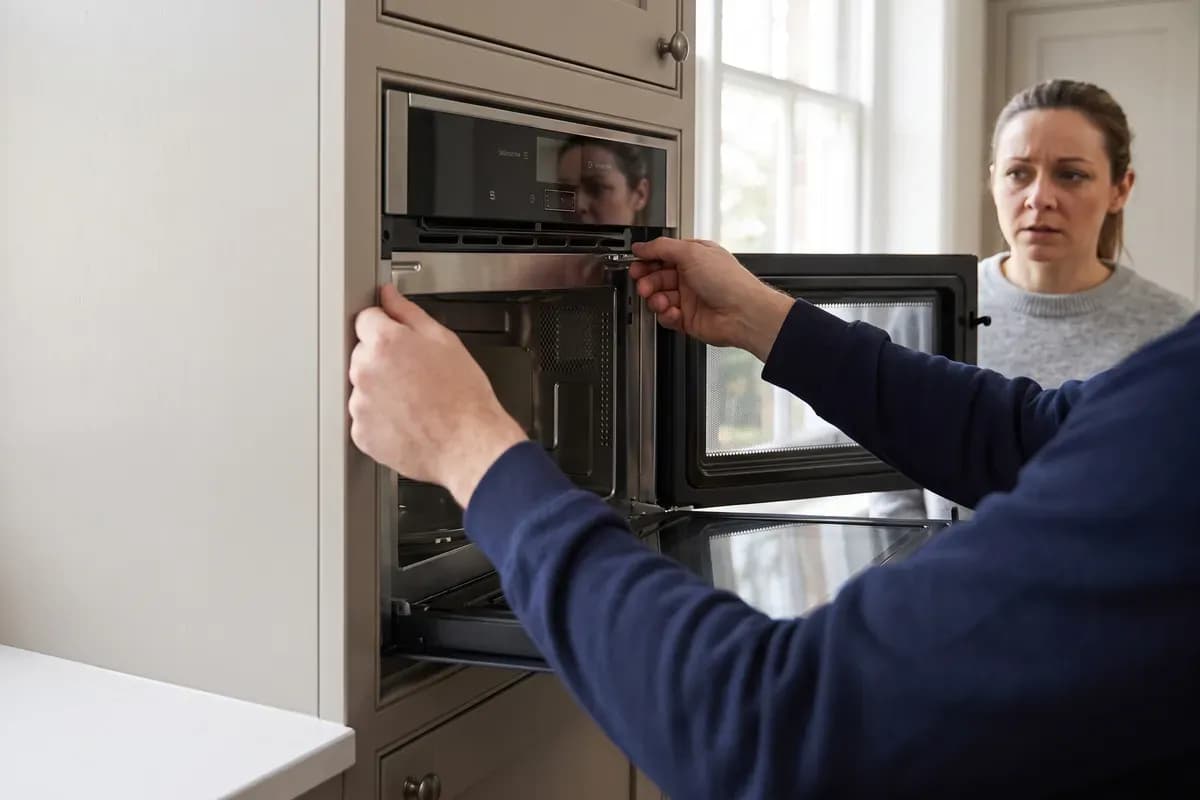
Microwave repair covers built-in and combination microwaves that run but do not heat, whose turntable will not turn, whose door will not latch or whose controls have stopped responding. We diagnose the fault in your kitchen and agree the cost before any work.
01How it works
Microwave Repair, explained
How it works
Your microwave, properly understood
Built-in and combination microwaves use a magnetron to generate high-frequency radio waves. These waves pass into the cavity and excite water molecules in the food, creating heat. Combination models also include standard electric heating elements and a convection fan to bake or roast, much like a conventional electric oven. High-voltage components, including a transformer, capacitor, and diode, step up the mains electricity to power the magnetron.
Why it fails
What wears out
Because these appliances rely on complex high-voltage circuits, a failure in any single component will stop the heating process. If the magnetron fails, the microwave will sound normal but the food will remain cold. Door switches are another point of failure. A microwave has multiple safety interlock switches in the door latch assembly. If the door hooks do not engage these switches properly, the control board will prevent the appliance from starting. Turntable motors can also burn out, leaving food to heat unevenly.
Microwaves check
- Heating and magnetron circuit
- Turntable motor
- Door switches
- Fan and lamp
- Touch controls
- Fuses and wiring
A proper diagnosis
From your call to repaired
Diagnosing a built-in microwave requires safely discharging the high-voltage capacitor before any internal testing begins. An engineer will use a multimeter to check the continuity of the door switches, thermal cut-outs, and the magnetron itself. For combination models, the convection elements and fan motors are tested individually. Once the faulty component is identified, it is replaced, and the appliance is reassembled. We repair electric cooking appliances for customers in Plymouth and the surrounding areas, but we do not work on gas appliances.
- 01You get in touchCall or send an enquiry. Tell us what it is doing, and the make and model if you have them.
- 02We come to your homeThe fault is diagnosed where the appliance stands.
- 03It is repairedThe repair is carried out in your home.
02Know the signs
When it is time to call us
01
The appliance runs through its cycle but the food remains completely cold.
02
The glass turntable stutters or fails to rotate when a programme starts.
03
The door feels loose and does not click firmly into the latch.
04
The digital display is blank and the touch controls do not respond.
05
The microwave stops abruptly after a few seconds of running a cycle.
06
The convection fan in a combination model makes a loud grinding noise.
03Common faults
What usually lies behind it
01
Microwave runs but does not heat
When the appliance sounds as though it is working but the food remains cold, the high-voltage circuit has usually failed. This points to a faulty magnetron, a blown high-voltage diode, or a failed capacitor. The control board might also be failing to send power to the transformer.
02
The glass turntable will not rotate
A turntable that fails to spin will cause food to heat unevenly. This is typically caused by a burnt-out synchronous motor located beneath the cavity floor. It can also happen if the glass tray is not seated correctly on the rotating coupling or the support ring.
03
Door latch fails to close properly
The door relies on plastic hooks engaging with a series of safety interlock switches. If the hooks break or the springs lose tension, the door will not close securely. The control board requires all safety switches to be activated before it will allow the microwave to start.
04
Touch controls are completely unresponsive
If the display is blank or the buttons do not respond to touch, the main control board or the membrane keypad has likely failed. A blown internal fuse or a tripped thermal cut-out can also cut all power to the user interface, leaving the appliance completely dead.
05
Combination microwave fails to bake food
Combination models use standard electric heating elements alongside microwave technology. If the appliance microwaves normally but fails to bake, the convection element or the circulation fan has likely failed. We test these electric components individually to find the fault. We do not work on gas appliances.
04Questions
Microwaves: your questions
Not answered here? Tell us the make, the model and what the appliance is doing.
Call 01752 922765No. Stop using it, unplug it and have it checked before it is used again.
This happens when the control board detects a fault in the high-voltage circuit or the door switches. If one of the safety interlocks drops connection as the appliance vibrates, the control board will immediately halt the cycle to prevent the microwave from operating with an unsealed door.
Yes, the door contains multiple safety interlock switches designed to prevent the appliance from running while open. If just one of these switches fails mechanically or electrically, the main control board will not receive the correct signal and will refuse to start any heating programme.
Combination models use a traditional electric element and a fan for their oven settings. If the convection element burns out or the fan motor fails, the appliance will not reach the target temperature. We repair electric cooking appliances in Plymouth, but we do not repair gas appliances.
The turntable is driven by a small electric motor located under the floor of the microwave cavity. If liquid spills into the motor shaft, or if the motor simply burns out from age, the glass tray will stop turning. The motor must be replaced to restore rotation.
05Where we work
Microwaves in your town
Choose your town for microwave repair there, nearest to Plymouth first.
Devon