
Our services
Electric Range Cooker Repair in Plymouth, Devon and Cornwall
Electric range cooker repair covers larger range cookers where one oven, the grill or the hob has stopped heating, where controls have failed, or where the cooker trips the electrics. We diagnose the fault in your kitchen and agree the cost before any work. Electric range cookers only, no gas.
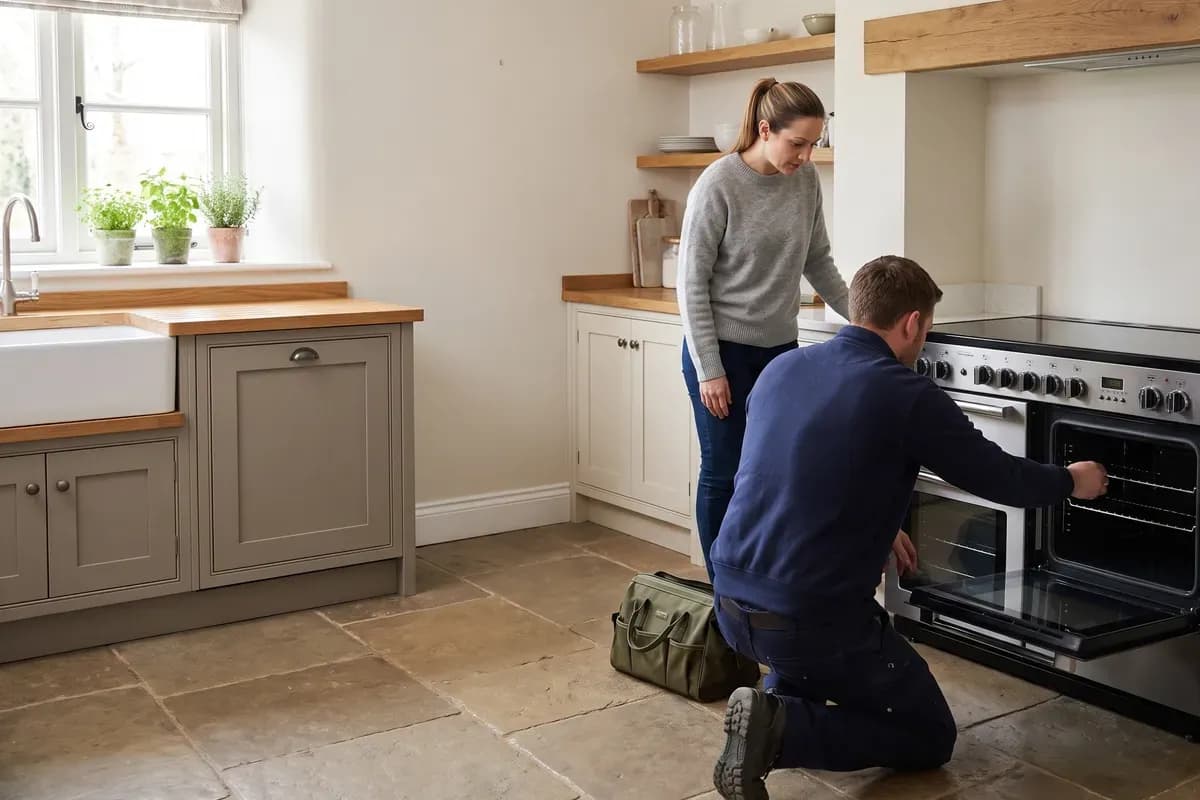
01How it works
Electric Range Cooker Repair, explained
How it works
Your range cooker, properly understood
Electric range cookers combine multiple cooking zones into one large appliance. They typically feature a main oven, a secondary oven, a separate grill, and a wide electric or induction hob. Each cavity relies on dedicated heating elements, cooling fans, and thermostats to regulate temperature. The hob uses either radiant elements under ceramic glass or electromagnetic coils for induction cooking. Power is distributed from a main terminal block through a complex wiring loom to individual selector switches and control boards.
Why it fails
What wears out
Because range cookers draw a significant amount of current, components are subjected to intense thermal and electrical stress. Fan oven elements degrade over time, eventually breaking down and failing to produce heat. Selector switches can melt or develop carbon build-up on their internal contacts, preventing power from reaching the elements. Cooling fans seize due to grease accumulation, causing the appliance to overheat and trip thermal cut-outs. On induction models, the printed circuit boards that generate the magnetic fields can suffer component failure, leaving cooking zones unresponsive.
Range Cookers check
- Heating elements
- Fan and fan motor
- Thermostat
- Door seal and hinges
- Switches and controls
- Wiring and connections
A proper diagnosis
From your call to repaired
Diagnosing an electric range cooker requires isolating the specific circuit that has failed. A multimeter is used to check the continuity of heating elements, thermostats, and thermal fuses across the affected oven or grill. The main terminal block and wiring connections are inspected for signs of heat damage or loose connections. If the appliance trips the electrics, insulation resistance testing helps locate earth faults within the elements or wiring. For hob faults, power delivery to the individual zones or induction modules is measured to determine if the issue lies with the control interface or the heating components themselves.
- 01You get in touchCall or send an enquiry. Tell us what it is doing, and the make and model if you have them.
- 02We come to your homeThe fault is diagnosed where the appliance stands.
- 03It is repairedThe repair is carried out in your home.
02Know the signs
When it is time to call us
01
The main oven takes much longer than usual to reach temperature.
02
One of the hob zones stays cold when turned up to maximum.
03
The household RCD trips immediately when you turn on the grill.
04
The digital clock is blank and the ovens will not turn on.
05
The oven door does not close flush against the front seal.
06
The temperature dial feels loose or spins without clicking into place.
03Common faults
What usually lies behind it
01
Main fan oven is blowing cold air
The circular heating element surrounding the fan blade can burn out. When this happens, the fan continues to circulate air, but the oven cavity will not heat up. Testing the element for continuity determines if it has failed and requires a replacement to restore normal cooking temperatures.
02
Range cooker trips the household electrics
A component with degraded insulation will cause a short circuit or earth leakage, tripping the circuit breaker or RCD. This is usually caused by a split heating element in one of the ovens or the grill, or damaged wiring near a heat source within the cooker casing.
03
Ceramic or induction hob zones not heating
Radiant ceramic zones rely on wire elements that can break, while induction zones use magnetic coils controlled by circuit boards. If a zone stops working, the fault could be a broken element, a failed simmerstat switch, or a faulty power module inside the induction hob assembly.
04
Oven overheats and burns the food
Temperature regulation relies on a thermostat communicating with the control switches. If the thermostat capillary tube is damaged or the sensor fails, the oven will not know when to cut the power. The heating elements stay on continuously, causing the cavity to overheat regardless of the dial setting.
05
Cooling fan is noisy or vibrating
Range cookers use internal cooling fans to keep the control fascia and switches from overheating. The bearings in these fans can wear down or become clogged with cooking grease. This causes a loud rattling noise and can eventually lead to the fan motor seizing completely.
04Questions
Range Cookers: your questions
Not answered here? Tell us the make, the model and what the appliance is doing.
Call 01752 922765No. We repair electric range cookers only.
Electric range cookers have a dedicated cooling fan designed to protect the electronic controls and switches from residual heat. This fan operates independently of the cooking elements and will continue to run until the internal temperature of the cooker casing drops to a safe level.
Intense heat over prolonged periods can cause the metal outer casing of the grill element to warp and sag downwards. If the element is drooping significantly, it can result in uneven cooking and indicates that the internal wire is deteriorating and may soon fail completely.
Range cooker doors are heavy and place a lot of strain on their hinges. When the internal springs stretch or the metal brackets wear down, the door will not seal properly. The hinges and the corresponding receivers inside the cooker frame usually need to be replaced together.
Error codes on an induction hob indicate a specific fault detected by the internal diagnostics. This could relate to an overheating power module, a communication error between the touch controls and the main circuit board, or a problem with the incoming electrical supply to the cooker.
05Where we work
Range Cookers in your town
Choose your town for electric range cooker repair there, nearest to Plymouth first.
Devon