
Our services
Dishwasher Repair in Plymouth, Devon and Cornwall
Dishwasher repair covers machines that leave water in the base, stop cleaning properly, will not heat, leak onto the floor or refuse to start. We diagnose the fault in your kitchen, explain it and agree the cost before any work begins.
01How it works
Dishwasher Repair, explained
How it works
Your dishwasher, properly understood
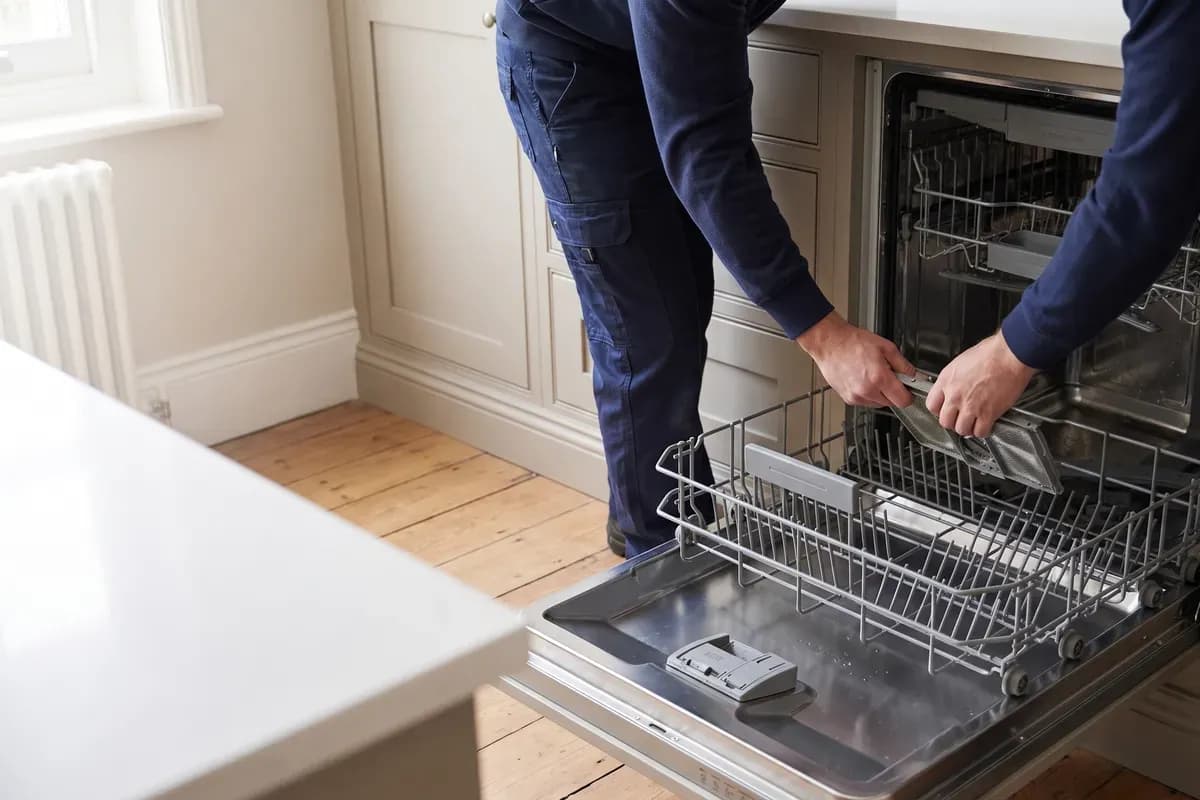
A dishwasher relies on a precise sequence of filling, heating, spraying and draining to clean plates and cutlery. Water enters through an inlet valve and is heated by an element to the correct temperature. A wash motor then forces this hot water through the spray arms, which rotate to distribute the water evenly across the load. Once the wash cycle finishes, a drain pump removes the dirty water. When a machine stops cleaning properly or refuses to run, the fault can lie in the mechanical components or the electronic control board. Wash motors can seize or degrade, leaving the spray arms without enough pressure to spin. Heating elements can fail, meaning the water stays cold and grease is not dissolved, which also leaves dishes wet at the end of the cycle. Drain pumps can become blocked by food debris or broken glass, causing water to pool in the base of the cabinet. Door seals can perish over time, leading to leaks onto the kitchen floor. Finding the exact cause requires testing the machine in place. We check the electronic error codes if the machine refuses to start, and inspect the physical components underneath the tub. By testing the resistance of the heater, the continuity of the wiring and the function of the pumps, we can pinpoint the exact part that has failed. All Appliance Care covers Plymouth and the surrounding areas in Devon and Cornwall, repairing freestanding and integrated dishwashers.
02Know the signs
When it is time to call us
01
Dirty water remains in the bottom of the tub after a cycle finishes.
02
The machine washes with cold water and fails to dissolve grease on plates.
03
Dishes and cutlery are still completely wet when you open the door.
04
Water drips from the bottom of the door onto the kitchen floor.
05
The spray arms do not spin and leave food baked onto the load.
06
The control panel flashes a sequence of lights and refuses to start.
03Common faults
What usually lies behind it
01
Draining faults and water in the base
A dishwasher that leaves a pool of dirty water at the bottom has a draining issue. The drain pump might be blocked by a piece of hard food or broken glass, or the pump motor itself may have failed and stopped pushing water into the waste pipe.
02
Poor cleaning results and spray arm problems
If plates come out dirty, the spray arms might not be spinning. This happens when the wash motor loses power and cannot generate enough water pressure. Blocked nozzles on the spray arms or a clogged central filter will also prevent water from circulating properly during the wash.
03
Heating faults and dishes left wet
Dishwashers need hot water to break down grease and dry the load. When a heating element or its associated thermostat fails, the machine washes with cold water. You will notice that the cleaning results are poor and the dishes remain completely wet at the end of the cycle.
04
Leaks and damaged door seal problems
Water leaking onto the kitchen floor is a clear sign of a problem. The main door seal can split or lose its shape over time, allowing water to escape. Leaks can also originate underneath the machine from a split hose or a damaged pump housing.
05
Error codes and machines that will not start
Modern dishwashers monitor themselves and will display an error code or a sequence of flashing lights if they detect a fault. A machine might refuse to start if the door latch is broken, the control board is faulty, or the anti-flood switch in the base is activated.
04Questions
Dishwashers: your questions
Not answered here? Tell us the make, the model and what the appliance is doing.
Call 01752 922765Yes. We repair both integrated and freestanding dishwashers.
A failure to drain is usually caused by a blockage or a faulty drain pump. Food debris, labels from jars, or broken glass can get past the filter and jam the pump impeller. If the pump is clear but still not working, the motor itself may have burnt out.
Leaks from the front of the machine are typically caused by a damaged or degraded door seal. If the water is coming from underneath the appliance, it could be due to a split internal hose, a leaking wash motor, or a loose connection on the water inlet valve.
If the dishes are both dirty and wet, the machine is likely not heating the water. The heating element is responsible for raising the water temperature to dissolve grease and for creating the heat needed to dry the load. A failed element will need to be replaced.
Yes, All Appliance Care repairs a wide range of domestic appliances. We work on washing machines, tumble dryers, fridges, freezers, electric ovens, electric cookers, electric hobs, cooker hoods and microwaves. We only work on electric and induction cooking appliances, and we do not work on any gas appliances.
05Where we work
Dishwashers in your town
Choose your town for dishwasher repair there, nearest to Plymouth first.
Devon